
Happy Friday to all our readers new and old, hopefully, everyone had a great Easter Sunday as we all did here at Sports Car Services. Today for our weekly “This Week in the Shop” I’d really like to take the time to touch on the Jaguar E-Type and give a brief history of this significant gem.
A couple of weeks ago I briefly touched on this gem and told you that The Jaguar E-Type is an English Sports Car, which was manufactured by Jaguar Cars Ltd between 1961 and 1975. Its combination of beauty, high performance, and competitive pricing established the model as an icon of the motoring world. the E-Type pounced on the scene with a top speed of 150 miles per hour, an acceleration of 0 to 60 mph in 7 seconds, monocoque construction, disc brakes, rack and pinion steering, independent front and rear suspension, and unrivaled looks.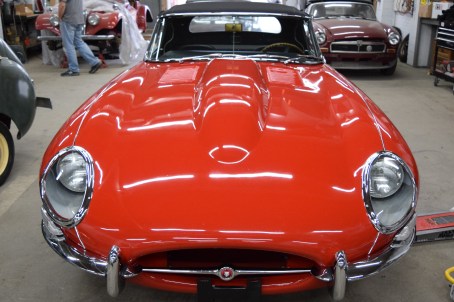
“Monocoque construction”, if you’re like me you probably read that and vaguely had an idea of what it meant and that it had something to do with the outer shell being a supporting member of the vehicle itself. Basically, in all essence, that’s exactly what it means. The E-Type was based on Jaguar’s D-Type racing car, which had won the 24 Hours of Le Mans for three consecutive years (1955–1957), and therefore employed the racing design of a body tub attached to a tubular framework, with the engine bolted directly to the framework.
The Jaguar E-Type was an amazing feat of automobile engineering, on its release in March 1961 Enzo Ferrari called it “the most beautiful car ever made” and he was not exaggerating. The E-Type dominated the foreign car market in its day and quite honestly, in my personal opinion, it still does. There were three different series in the course of its reign from 1961-1975:
The E-Type Series I was produced from 1961- 1968 and featured the triple SU carburetted 3.8-litre six-cylinder engine from the XK150S until 1964 when the 3.8-litre engine was increased to 4.2 litres in October 1964. All E-Types featured independent coil spring rear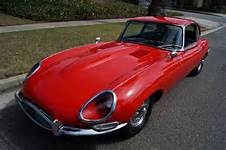 suspension with torsion bar front ends, and four-wheel disc brakes, in-board at the rear, all were power-assisted. Jaguar was one of the first vehicle manufacturers to equip cars with disc brakes as standard from the XK150 in 1958. The Series 1 (except for late models) can be recognized by glass-covered headlights, small “mouth” opening at the front, signal lights and tail-lights above bumpers and exhaust tips under the number plate in the rear.
The E-Type Series II was produced from 1968-1971 and introduced a number of design changes, largely due to U.S. design legislation. The most distinctive exterior feature is the absence of the glass headlight covers a wrap-around rear bumper, re-positioned and larger front indicators and tail lights below the bumpers, an enlarged “mouth” which 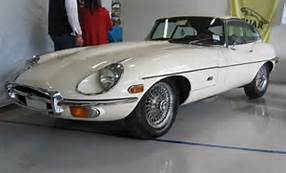 aided cooling but detracted from the Series I design purity, twin electric fans, plastic rocker switches in place of the Series I toggle switches, and, of course most importantly, a material downgrading in performance resulting from a switch from the three SU carburetors used in Series I models to a mere two “smogged” Stromberg carbs, reducing horsepower from 265 to 246 and reducing torque from 283 to 263.
The E-Type Series III was produced from 1971- 1975 and featured a new 5.3 L twelve cylinder Jaguar V12 engine, uprated brakes and standard power steering. The choice of an automatic transmission, wire wheels and air conditioning were available. The brand 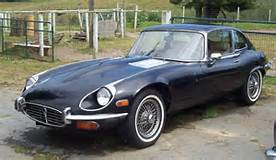 V12 engine was equipped with four Zenith carburetors. The final engine was claimed to produce 272 hp, more torque and a 0-60 mph acceleration of fewer than 7 seconds. The short wheelbase FHC body style was discontinued, with the Series III available only as a convertible and 2+2 coupé. The newly used longer wheelbase now offered significantly more room in all directions. The Series III is easily identified by the large cross-slatted front grille, flared wheel arches, wider tires, four exhaust tips and a badge on the rear that proclaims it to be a V12.

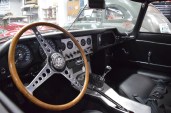 basic check-up, the list is growing but nothing too serious. The Jaguar E-Type is a British sports car, which was manufactured between 1961 and 1975. Its combination of high performance, competitive pricing and elegance established the
  model as a staple of the motor vehicle industry. At a time when most cars had drum brakes, live rear axles, and mediocre performance, the E-Type burgeoned on the scene with 150 miles per hour for a top speed, and 0 to 60 mph acceleration time, monocoque (structural skin) construction, disc brakes, rack and pinion steering, independent front-end and rear-end suspension and unsurpassed looks. The interior of the E-type is beautiful and the body and mechanics of the car, in general, are in great condition and nothing too serious is wrong with it. The check-up is specifically focusing on mechanical aspects and Mike has been working for the better part of the week diagnosing what is necessitated with it from basic wear and tear. He’s also going to be re-tuning the triple carburetor system and there is a small issue with the driver’s side caliper, which is causing it to stick, and the best option for that is to rebuild the caliper in general, both of which are lost art forms that not many garages will do.
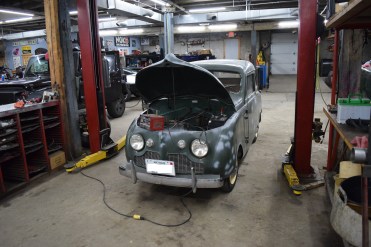 The Crosley is still here in the Sports Car Services garage and should be making its trek home shortly. Everything that we were asked to fix on it has been done, and its running great now. We did not fully restore this car and there is still plenty of work that could be done on it, but we at least got it on the road. A fully restored basic Crosley is worth anywhere from 10 to 15 grand. A Crosley H-Mod classic racer , on the other hand, is worth much more, anywhere from 25-35 grand.
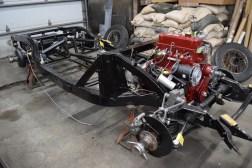 eventually be fully rebuilt from the frame up. The MGA Mark I replaced the MG TF 1500 Midget (like the one I wrote about a few weeks ago) and represented a complete style change from MG’s earlier sports cars, the Mark I was of course eventually replaced by the Mark II. Announced on September 26, 1955
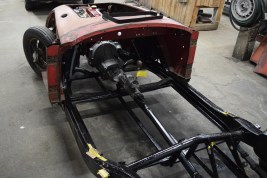 attached to the bottom rather than the top of the frame sections. Road & Track magazine reviewed the MGA Mark II in the September 1961 issue and reported a top speed of 105 mph and a 0-60 acceleration of 12 1/2 seconds. The frame on the MGA Mark II that we’re working on is just like brand new, the engine is in mint condition and has been rebuilt to standards of a brand new engine and the drive-train, as well, is in very good condition. Albert spent a good part of the week running brake lines, as well as fuel lines for it, the next step will be to finish the body.
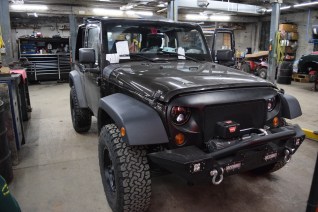 Jason and Rod are still busy in our brother shop, G&R Autoworks LTD, getting the Jeep rebuild finished. There has been a lot of modifications on this project. Utility boxes have been added all around it as well as a new winch. That isn’t even half of it though, they have Installed new ball joints , the front axle U-joints, replaced both front axle seals, full E-brake service requiring a redesign to the original automatic adjusting system that everyone complains about, installed new wheels and tires, installed headlights. The list is just starting to grow and who knows what else we’ll be modifying next.
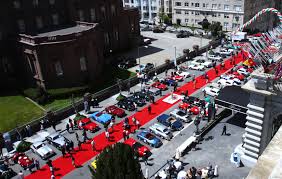 Well, what exactly is the California Mille you may be asking, The California Mille is a run, not a race, starting in San Francisco and continuing into the redwood forests of the Santa Cruz Mountains to Monterey and along the Big Sur coast toward Carmel. It is open to cars that either ran or would have been eligible to run in the original event; hence participants cars must be designs from 1957 or earlier. The California Mille field is limited to 65 cars and applicants are screened for their car’s historical significance and general condition; not all applicants are accepted.
 from 1927 to 1957. From the years 1953 until 1957 it was also included as a round of the World Sports Car Championship. The race was banned after two fatal crashes. The first was in 1957 when the crash of a 4.2-litre Ferrari 335 S took the lives of the driver Alfonso De Portago, his co-driver/navigator Edmund
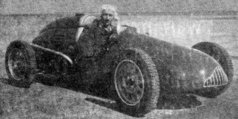 Nelson, and nine spectators. The car supposedly landed on top of Portago and Nelson cutting them in half. Portago desperately wanted to win this race and made the grave decision to wait to long to make a tire change. The second crash was much less devastating, although it took the life of Joseph Gottgens and his Triumph T3.
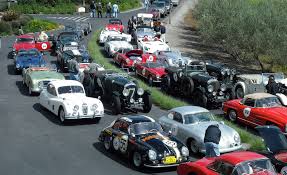 (“American friends of the Mille Miglia” in Italian). The event attracts a number of corporate sponsors which have included in the past Jaguar, Chrysler and Sotheby’s as well as many others this corporate sponsorship ensures that the California Mille remains one of the more exclusive and high quality events.
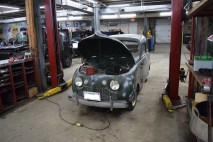 and shipped out next week thanks to Albert and Gary for doing an
  extremely precise job on it. The interior in the MG is coming along just great and Albert will be heading to the seacoast to do the seats next week. Mike’s been busy overseeing the Sports Car Services garage in its entirety. He’s been right out straight working on the Spitfire, repairing a few different electrical malfunctions as well as countless other projects such as getting the Jaguar XK120 prepared for shipping to California
 ![DSC_0057[1]](https://sportscarservices.org/wp-content/uploads/2017/03/dsc_00571.jpg?w=230&h=153) for the “California Mille”. The California Mille is a classic car run that last four days and travels throughout northern California. The event is open to cars manufactured prior to
for the “California Mille”. The California Mille is a classic car run that last four days and travels throughout northern California. The event is open to cars manufactured prior to ![DSC_0053[1]](https://sportscarservices.org/wp-content/uploads/2017/03/dsc_00531.jpg?w=221&h=147) Jan. 1st, 1958. Approx. 65 cars are chosen from those submitted for entry. This year will be the 27th anniversary. The run is in the spirit of the original Italian Mille Miglia which ran from 1927-1957, and all entries must be cars that did, or could have, participated in the original Mille Miglia during the years of 1927-57, and can be of foreign or domestic manufacture.
Jan. 1st, 1958. Approx. 65 cars are chosen from those submitted for entry. This year will be the 27th anniversary. The run is in the spirit of the original Italian Mille Miglia which ran from 1927-1957, and all entries must be cars that did, or could have, participated in the original Mille Miglia during the years of 1927-57, and can be of foreign or domestic manufacture.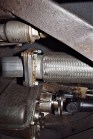 is to finish building the exhaust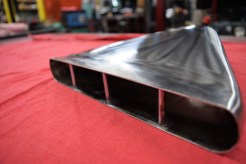
 logistics trying to decide on, and order, all the modifications needed for the 2013 Jeep
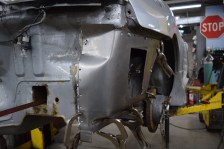 that received a lot of body work which Rod did a phenomenal job on, talk about a perfectionist at wire feed welding!. We’re also expecting the arrival next week of a 1970 Jaguar E-type Series II, that’s going to be quite the project, and I look forward to covering the story on that beauty.

 Sports Car Services